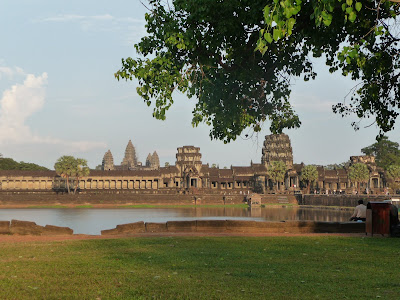
The temples of Angkor, ancient home of the Khmer empire, the world’s 6th wonder, and a spiritual stop on my list. I figured it might be a good spot to renew my meditative vows that had been waning since my stop at the silent forest monastery in Australia. Luckily, I met a Dutch guy in Vietnam who was also into meditation (like, really into it…. talks about light bodies and chakras and stuff.), so we made plans to meet in the lotus position in front of Angkor Wat.
It was a date I really anticipated since I figured the peacefulness of the expansive temples would seep into my bones and ingrain into me the act of calm meditation.
And when I got there, I knew it would happen. The place was shocking. Really. Evidence of a truly spiritual group of people. I guess it was more than a group. In fact, the Khmer empire used to span the whole of Southeast Asia from the 9th to the 13th centuries. There were over a million inhabitants at a time when London housed only 50,000. It was a big deal, and I don’t remember ever learning about the Khmers from the Illinois school system. In fact, I don’t remember learning about anything but pilgrims and Abe Lincoln in my ‘history’ classes growing up. Either I was too busy writing notes to Chris Apostolopoulos or public schools in the states have forgotten about the world. Or maybe my memory disappeared during college. Whatever the reason, I was shocked to learn that such a beautiful culture existed for so many people and is still very much alive today in Cambodia.
The city of Angkor was the political, religious, and social center of the Khmer empire, and each monument in it houses more symbolism than Citizen Kane. Not a sliver of temple is left without a carved deity or message, mostly about worshipping Hindu gods. But also about Khmer history. King Jayavarman VII, a king born from the Gods, made it his mission to have the history of Khmer/Cham battles carved into the most important of temples. He wanted to preserve history in a most beautiful way. The current and last God King, His Majesty Sihanouk, funded the Khmer Rouge and asked that he be able to rule away from the throne so he could focus on his movie career. I think the genes of the Gods really start dwindling after being passed on so many times.
To walk through the hallways of Ankgor Wat is a playground for the imagination. Though the peaks have crumbled and there are weeds creeping through many of the cracks, the grandeur of the place is undeniable, and I found so much pleasure in simply sitting on a windowsill and imagining the worshipers who used to wander through the same halls thousands of years ago. It made me really appreciate period pieces. I finally understand why people like to recreate a different era for the cinema. I still won’t ever see Marie Antoinette because frankly I can’t stand to look at Kirsten Dunst’s teeth, but I now understand the magic in the recreation.
To meditate at Angkor Wat is another story. Not only are there ants the size of mice lurking under every Banyan tree, there are even bigger tourists lurking in front of every bas-relief. It is the most unspiritual spiritual place I’ve seen.
So, after seeing the temples every morning, the Dutch guy and I would ride bicycles to Siem Reap, the area of town built specifically for those same tourists. And we would eat. A lot. For most Khmers, the key to economic freedom lies in the hospitality industry. They’ve created an entire Disneyland-like town devoted to gourmet restaurants.
In order to support the Khmers in their mission to capitalize in the culinary, we ate. My mouth made acquaintance with warm goat cheese salads, crispy vegetable samosas, tofu stuffed with raisins and cashews, red curries, creamy pumpkin soups, and even plates of French cheeses. Everything made my esophagus sing. I couldn’t get enough. After each meal, I felt pangs of sadness because it meant I would not be able to eat for a few hours. Sometimes I did anyway. I ate several croissants on the hour.
We figured it was the best way to see the temples, an hour or so in the morning (after a large mango pancake and pineapple shake, of course) and then to the food! When we took a day off from the temples, we spent our time in the kitchen learning how to make local Khmer dishes! Amok is the most popular, a curried mix of lemongrass and galanga and keffir lime leaves. Mine came out on the bland side, but it looked nice served in a folded banana leaf.
When it was all over, we had stayed in that fake town for 9 days. 9 DAYS OF EATING. My stomach is surely a deflated balloon.
When meditation involves cheese, I will definitely make it a priority.
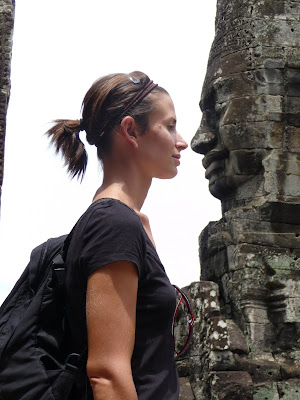
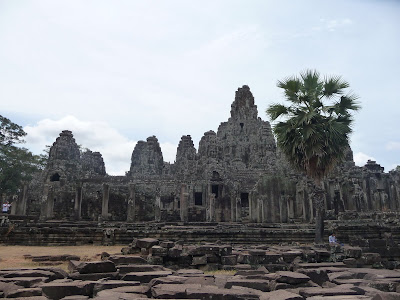 The exterior of Bayon, my favorite temple. If you look close, you will see thousands of elaborate faces carved into the stone.

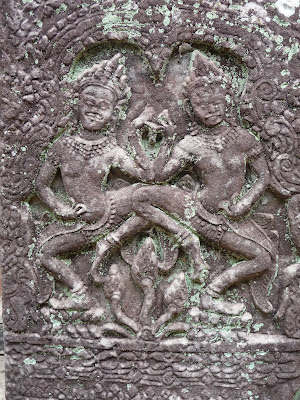 These are the aspara dancers, a very important part of Khmer culture. The God kings used to have thousands of dancers perform for them at once inside the temples.
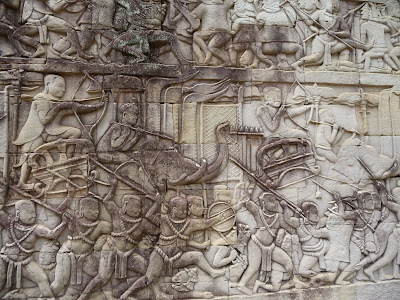 This relief depicts a battle between the Khmers and the Chams.
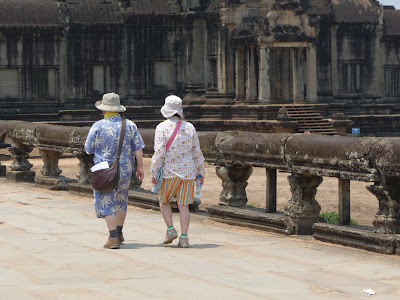 Best tourists ever.

 it seems that those who don’t read are kind of proud of it. If the only book I’d ever read was on the required list in junior high, I probably wouldn’t tell anybody. (But I’d also give books another chance. I mean… Where the Red Fern Grows? The only book? I can see why you may have been turned off, my friend, but at least try another. Read Maus if you have to. Geesh. [that’s a comic book- get it?])